
 The average day of the average worker in America has completely changed in the past century. We used to be a nation of laborers, farmers, manufacturers, deliverers. We are rapidly becoming a nation of commuters and computer workers. We sit in the car on the way to work. We sit at work. We sit at the cafeteria table. We sit at work some more. We sit in the car on the way home from work. We're exhausted, so we sit on the couch to watch television after sitting at the dinner table. If you've spent eight hours a day in front of a computer, you realize what hard work it is, too. It's very stressful. The human body was not meant to sit for such long stretches at a time. The body is designed to move, to be on the move, to be active. Work is changing from eight hours of activity to eight hours of stressful physical inactivity. Here's another way to think about it. We have so many colorful and useful verbs for human activity: walk, run, dash, spring, sprint, jog, push, exert, nudge, shove, pull, tow, tug, paddle, drag, lift, heave, toss, throw, dig, shovel, hoe, and so on. In comparison, how few words are there for a static posture? Sit. Lounge. Relax. That's about it. If the human body is meant to be so active, there must be consequences if the body becomes inactive. And there are. Multiple recent studies and news articles have drawn attention to the health impact of a sedentary lifestyle. This article from the Daily Mail makes the startling claim that every hour of watching television shortens your lifespan by an estimated 22 minutes: And viewing TV for an average of six hours a day can cut short your life by five years. How can they back up this claim? How do they know that chronic sitting is bad for your health? A 2010 article in the journal Exercise and Sports Sciences Reviews made the point that sitting actually changes your metabolism: The physical, economic and social environments in which modern humans sit or move within the contexts of their daily lives have been changing rapidly, and particularly so since the middle of the last century. These changes — in transportation, communications, workplace and domestic-entertainment technologies — have been associated with significantly-reduced demands for physical activity. However, these reductions in the environmental demands for being physically active are associated with another class of health-related behaviors. More: Common behaviors in which humans now spend so much time — TV viewing, computer use and electronic games, sitting in automobiles — involve prolonged periods of these low levels of metabolic energy expenditure. It is our contention that sedentary behavior is not simply the absence of moderate-to-vigorous physical activity, but rather is a unique set of behaviors, with unique environmental determinants and a range of potentially-unique health consequences. Our population-health research perspective is on the distinct role of sedentary behavior, as it may influence obesity and other metabolic precursors of major chronic diseases (type 2 diabetes, cardiovascular disease, and breast and colon cancer). We also know that prolonged sitting stresses the ligaments of the lumbar and cervicothoracic spines, making those areas of the body more prone to disc herniation, chronic inflammation, and subluxation.
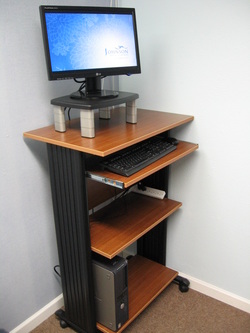
But it's more than just physical and metabolic health. Another 2010 article, this from the journal Applied Physiology, Nutrition, and Metabolism, mentions other concerns, such as the connection between a sedentary lifestyle and decreased psychosocial wellness. The authors draw attention to a number of fascinating studies, one of which draws an interesting parallel between increased television watching time and decreased academic success and college degree attainment. If we acknowledge that a sedentary lifestyle is bad for our bodies and our minds, how can we shoehorn in enough exercise time? Well, here's an easy way: do whatever you can to stand at work. The majority of your work day is spent at work, so do as little sitting as possible when at work. This will allow you to relax at home with relative peace of mind. Earlier this year in my office at Johnson Family Chiropractic of Peoria, I installed a standing desk (pictured above). This allows me to type patient notes and electronic health records while standing. It has been an excellent addition to my lifestyle, and prevents me from flopping into a computer chair. It forces me to maintain proper posture and to remain in a physically active state. When the body is physically active, the mind may also be physically active. I highly recommend the use of a standing desk for all computer workers. Random fun fact: did you know that Ernest Hemingway used to stand while writing? Mr. Hemingway may have had several other habits that negatively impacted his health, but he got this one right!
2 Comments
12/27/2012 02:23:21 pm
Inactivity is the downfall of so many, myself included. The moment we stop being active is the moment we start feeling worse and sickness of any kind creeps in. I always encourage my patients to be active as much as possible and to not let work or education overtake them with inactivity. Your comment will be posted after it is approved.
Leave a Reply. |
Categories
All
DisclaimerUnless otherwise attributed, all content is written by Kyle Johnson, DC, of Johnson Family Chiropractic of Peoria.
All images used are under Creative Commons license. Although every effort has been made to provide an accurate description of our chiropractic care and its benefits, the information given on this website and blog is not intended to be, nor should it be interpreted as, medical advice for any condition. If you have any questions regarding your condition, you should seek the help of Dr. Johnson in person, so that he may properly assess your condition. This blog is provided by Johnson Family Chiropractic of Peoria, S.C., proudly located in Peoria, IL. |
 RSS Feed